half at risk | 8 nights | from $4,620 per person
What Cloud Takes From the Yukon Vacation Package
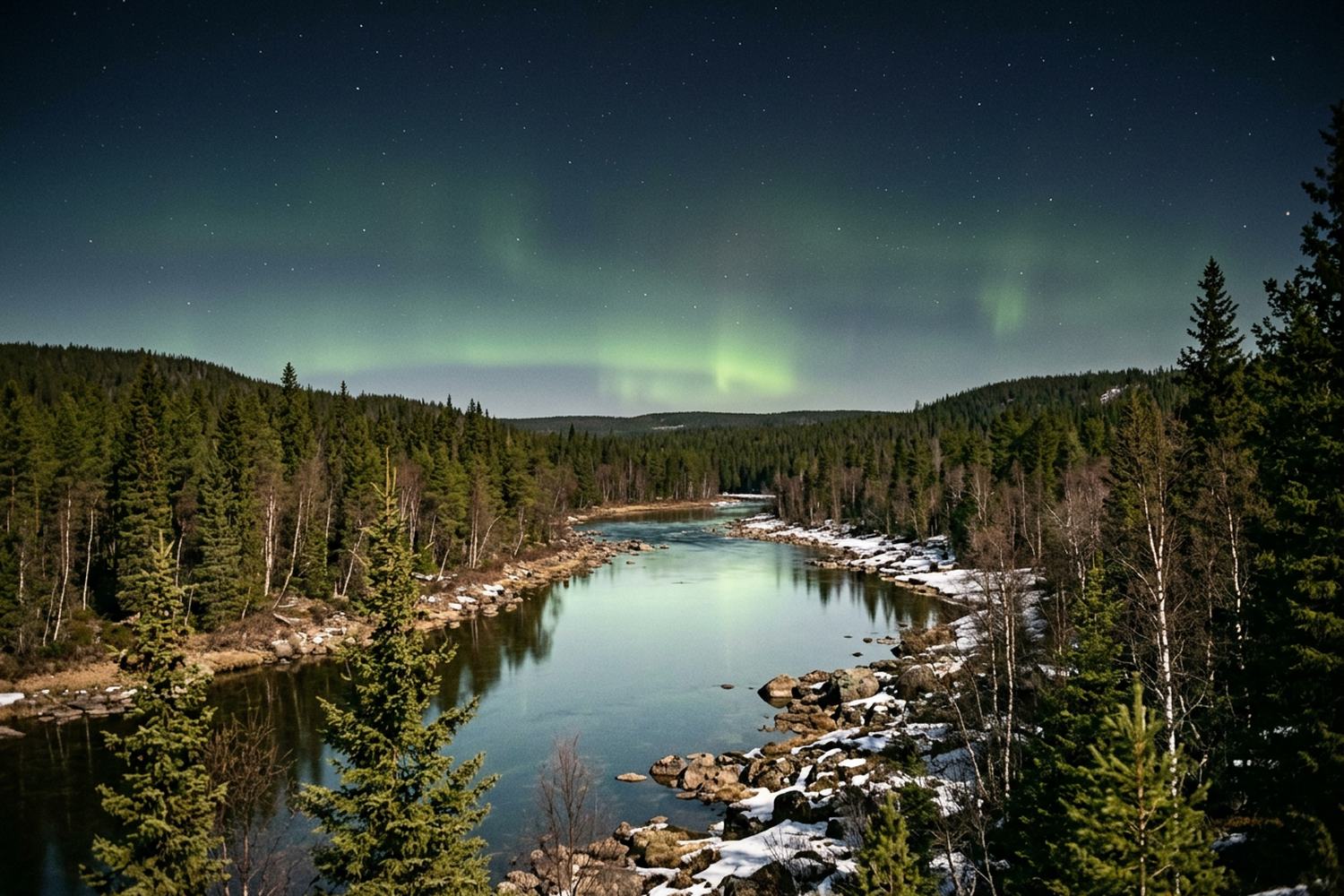
Aurora is why people book the Yukon vacation package, and aurora needs a sky that is not there half the time. Eight nights, three of them held for it, and no money back when the cloud stays.
What half at risk means here
- What the weather can cancel
- The aurora. Three of the eight nights are held for it, and each needs a sky that stays clear between 10pm and 2am; cloud ends the sighting outright and a bright moon thins whatever is left. The dog team day and the road driving run in almost anything.
- How often it actually happens
- In February and March roughly 2 nights in 5 are clear enough to see anything; December and January run closer to 1 in 3. Cloud arrives here as multi-day systems rather than at random, so the chance of eight nights producing none is nearer 1 in 10 than the 1 in 40 that independent nights would suggest.
- What you do instead
- The held nights go ahead regardless. You drive out, the stove is lit, and you stand outside in shifts for two or three hours looking at cloud, and the guide will chase a break up the valley by road if one is within an hour. Nothing is substituted and nothing is added to the week.
- What money comes back
- None. Those nights are sold as guide time, transport and a heated site, and all three are delivered whether or not the sky opens. No company involved in this trip pays out for cloud, and insurance of any kind is not arranged here.
- Who should not book this
- Anyone with one shot at this who will be angry to come home without a photograph. Also anyone unwilling to stand outdoors at minus 25C for two hours on a night that may end with nothing at all.
The fourth row is the one this trade prints smallest, and on most of these trips it says nothing comes back. It stands above the price deliberately.
What the price carries
- Eight nights of lodging: six in a mid-size hotel in downtown Whitehorse, two in a lodge about 30 minutes south, both with a private bathroom and heat you control yourself.
- Three guided aurora nights, 10pm to 2am, at a wood-heated site roughly 40 minutes from town lights, with a driver who stays until you decide to leave.
- A full day with a dog team: about four hours driving your own six-dog line, with a break and a walk through the kennel in the middle of it.
- Full winter outer layers, boots, mitts and a face cover for the entire eight nights, sized before you arrive and swapped on the first evening if anything fits badly.
- All ground transport inside the territory, roughly 320 road miles, including the airport runs and the drive out to the hot springs.
- Breakfast every morning and four dinners, two of them at the lodge, where there is nowhere else to eat.
What the price leaves to you
- Airfare into Whitehorse from anywhere in the lower 48. It sits outside this figure and is priced on its own, and nearly every routing connects at least once.
- Lunches, drinks and anything bought in town. Budget about $40 a day.
- Entry documents for Canada, and travel insurance of any kind. Neither is arranged here and no provider is recommended.
- Extra aurora nights bought locally when the week has gone badly, at about $150 per person per night.
- Tips for guides and mushers, which are expected and are not built into the figure.
What it costs
from $4,620 per person
- Covering
- 8 nights, eight nights in the subarctic north, aurora nights plus a dog team day, road-based.
- Taken as read
- A room shared between two, except where any of the six otherwise for your case.
- What lifts it
- A crowded month, a better room, a decision left late, and every hour you hand to somebody else to arrange.
- When it stops moving
- The moment an operator signs its own name under it. Before that, read it as the floor of a spread this desk has actually seen.
You settle with the operator, through whatever system they run. Not a cent of it passes through here, and this office never sees a card.
The months this runs, and the ones it does not
The season opens in the last week of November and closes in the first week of April. February and March carry it. The sky is fully dark by 7pm, the air is dry, and settled high pressure is common enough that clear-sky frequency runs near 45 percent.
December and the first half of January are the weeks I would talk somebody out of. Cloud parks over the valley three and four days at a stretch, daytime temperatures sit near minus 20C with runs down to minus 35C, and the dog day gets shortened for the animals more often than for the people.
After the first week of April the sky no longer goes properly dark until close to midnight, and trail ice on the sled route stops being predictable. That is a hard end rather than a soft one, and it is the part of the Yukon vacation package calendar that argues most against booking late.
Decisions left until confirmation
Fix the dates and four separate questions close behind them. Which three of the eight nights are held for aurora, picked about ten days out against the forecast rather than at booking. Whether the dog day runs full or as a half with an afternoon back in town. Whether the last two nights sit at the lodge or in Whitehorse, which changes the drive on your final morning. And boot and layer sizes, which go to the company supplying the clothing three weeks ahead so that anything odd can be found before you land.