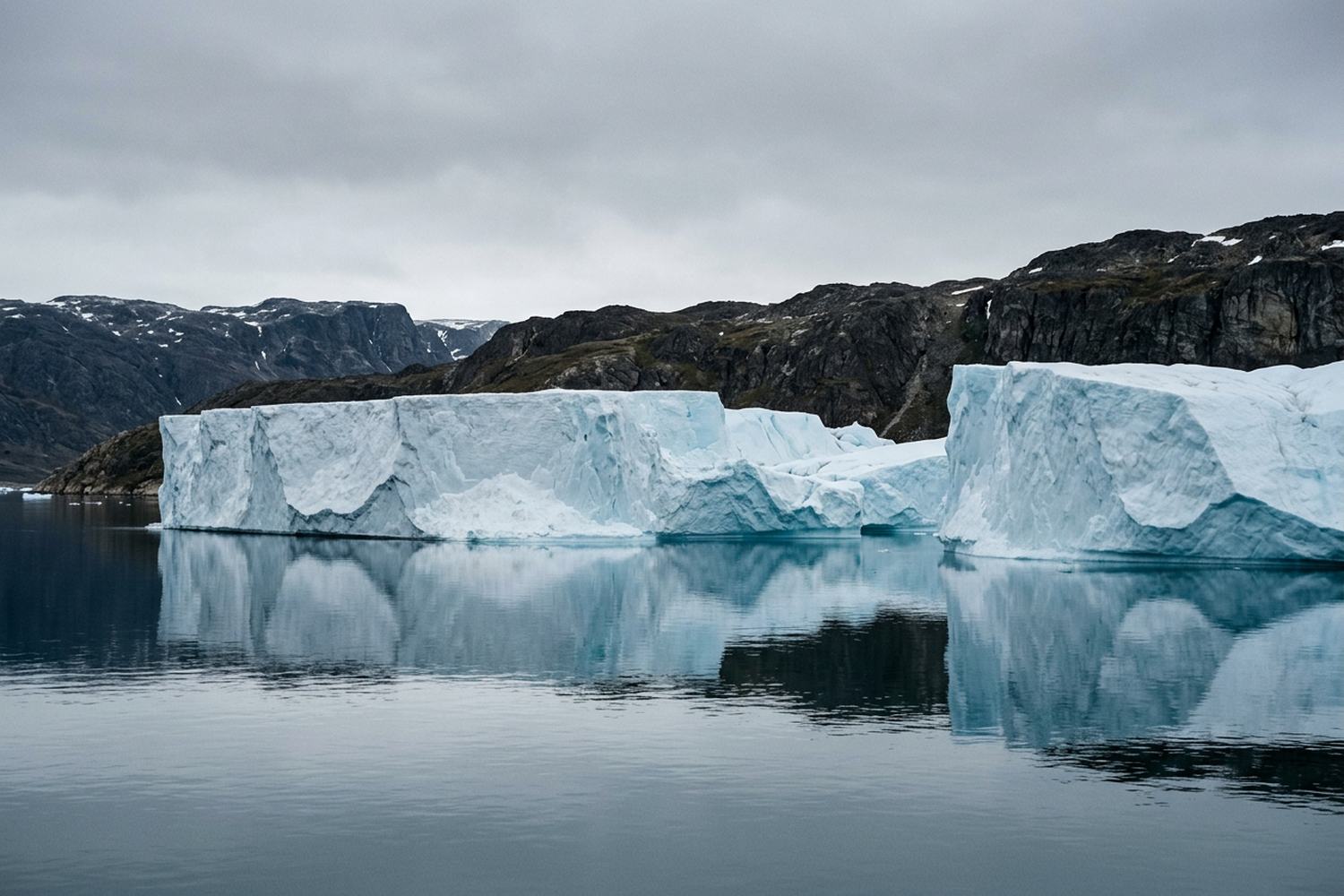
half at risk | 9 nights | from $7,240 per person
Greenland Vacation Package: Nine Nights, Half at Risk
This Greenland vacation package puts four weather-dependent legs inside nine nights. On a bad run you lose two of them, wait out the gap in a settlement of 4,500 people, and pay the same price you were quoted.
What half at risk means here
- What the weather can cancel
- Four legs run on conditions: the fixed-wing hop north from the hub airport, the return sector, a full day on the water in Disko Bay, and the boat crossing to the second settlement. Low cloud on the airstrip, fog off the ice edge, or wind above roughly 25 knots stops any of them, and the boat day is the one people came for.
- How often it actually happens
- In July and August roughly one day in three carries enough fog, low cloud or wind to move a small-aircraft or open-boat leg. Across four such legs that works out at about half of these trips losing one leg outright and about one in six losing two or more.
- What you do instead
- You wait, in the settlement you are already in. Delayed sectors are rebooked in departure order, so a canceled morning flight usually becomes the following morning, the lost nights come off the far end of the trip rather than the front, and a boat day that misses both its slot and its fallback date is not swapped for anything else.
- What money comes back
- None from us, and in almost every case none from the carriers or the boat operators: weather cancellations are rebooked, not repaid, and nights you have already slept are spent. Extra hotel nights caused by a delay are billed to you at the door. Travel insurance is not arranged here and no provider is recommended.
- Who should not book this
- Anyone with a fixed return date, a tight connection home, or nine nights that cannot stretch to eleven. Also anyone who wants to be told it will probably be fine, because on this itinerary it is fine about half the time.
The fourth row is the one this trade prints smallest, and on most of these trips it says nothing comes back. It stands above the price deliberately.
What the $7,240 covers
- Nine nights ashore in two west coast settlements, five in the first and four in the second, private bathroom in both.
- All four internal legs booked as one chain, two fixed-wing sectors and two boat crossings, so a delay on one moves the others instead of stranding you between separate bookings.
- A full day on the water in Disko Bay, with a named fallback date later in the week if the first attempt is canceled. That second date is the difference between this trip being half at risk and all of it.
- Breakfast daily, and dinner on the six evenings when there is nothing else open within walking distance.
- Transfers at both ends, including the long road leg out of the hub airport.
- Loan of an insulated flotation suit and boots for the boat days, sized before you leave.
- A printed running order with every weather-dependent leg marked and its fallback date written beside it.
What sits outside that figure
- Getting to the country. Air travel from North America to the hub airport is priced on its own and has run from about $1,150 per person round trip in June and September, higher through the middle of July.
- Nights added by weather. Rooms and meals during a delay are yours to settle: allow from about $260 per person per night, for two or three of them.
- Lunches, alcohol, laundry, and anything bought on board.
- A second boat day, which adds from $340 per person and raises the chance that at least one of them sails.
- Travel insurance. Not arranged here, not recommended here, in either direction.
- Anything over the internal baggage allowance of 20 kg. When a small aircraft is weight limited, bags are offloaded before passengers are.
What it costs
from $7,240 per person
- Covering
- 9 nights, coastal trip between two settlements, four legs by small aircraft and open boat.
- Taken as read
- A room shared between two, except where any of the six otherwise for your case.
- What lifts it
- A crowded month, a better room, a decision left late, and every hour you hand to somebody else to arrange.
- When it stops moving
- The moment an operator signs its own name under it. Before that, read it as the floor of a spread this desk has actually seen.
You settle with the operator, through whatever system they run. Not a cent of it passes through here, and this office never sees a card.
Which months hold and which do not
The trip runs from mid June to mid September, and the three parts of that window behave differently. Late June and July give the longest light and the calmest sea, and also the most fog, because warm air sitting over cold water off the ice edge puts low cloud straight onto the airstrips. Ilulissat records around 11 days with precipitation in July.
August holds the steadiest balance. Disko Bay is open water throughout, wet days run to about 12, and whole-day fog events are less common than in July. September is clearer overhead and rougher underneath: Atlantic lows arrive in sequence from the second week, wind above 25 knots closes open water crossings on several days a month, and daylight falls by roughly six minutes a day. The boats still run. They run less often.
Two stretches I would talk you out of. The first ten days of June, when drifting ice can still close the northern crossing and the boat day is not a boat day at all. And the last week of September, when one stationary low can take four of your nine nights with no later week to move them into.
Decisions still open at confirmation
Four decisions wait on your confirmation and cannot be made ahead of it. Which settlement is your first base, since the order decides which crossing carries the fallback day. Whether you take two boat days instead of one. Whether arrival day includes a night at the hub before the internal sector, which most people should take. And the exact fallback date, written into the running order so you can see, before you pay anything, which day is being held in reserve.