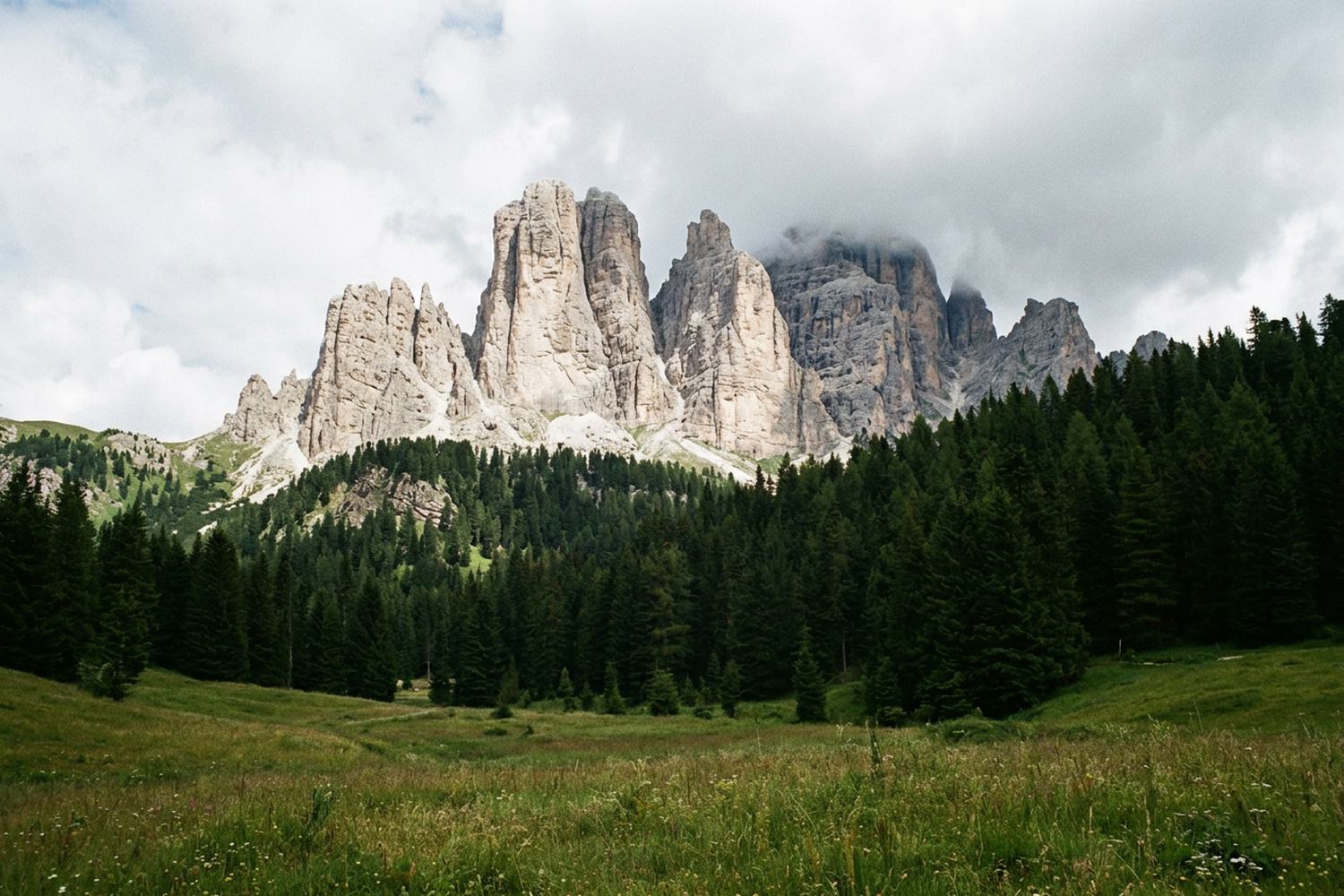
a day at risk | 8 nights | from $2,760 per person
One Day at Risk on the Dolomites Vacation Package
Two days of the Dolomites vacation package sit on cable cars that stop in high wind. The other six run at valley level and go ahead in rain.
What a day at risk means here
- What the weather can cancel
- The two cable car days. Both high routes start with a lift, and the lifts stop when gusts pass roughly 40 mph or when lightning is inside the valley. Without them, the 8,200-foot ridge traverse and the via ferrata day do not happen at all.
- How often it actually happens
- Between late June and late September the upper stages are shut for wind, storm or overnight icing on about 1 day in 6, and in July and August a thunderstorm builds on roughly one afternoon in three. Over two high days that is near a 30 percent chance of losing one of them and near 3 percent of losing both.
- What you do instead
- The day drops to the valley: a 7 to 11 mile walk between villages at 3,000 to 5,000 feet, which goes ahead in rain, plus the spare set of lift passes held back in case a window opens later in the week. If the weather stays shut all eight nights, the traverse simply does not get walked.
- What money comes back
- None. The lodging, the guide and the transfers are paid whether or not the lift turns, and a closed lift returns nothing for a day you did not ride. No money is collected here in the first place, so nothing comes back from this side either. Insurance is not arranged by this agency.
- Who should not book this
- Anyone whose reason for the eight nights is the ridge photograph. If those two days are the trip, a fixed week in these mountains cannot promise them. It is also wrong for anyone who cannot walk 8 miles with 1,500 feet of climb, because that is exactly what the replacement days ask.
The fourth row is the one this trade prints smallest, and on most of these trips it says nothing comes back. It stands above the price deliberately.
What the $2,760 pays for
- Eight nights in small family-run lodging across two valleys, five nights in the first and three in the second, both within walking distance of a village bus stop.
- A valley-based mountain guide on both high days, who reads the forecast at 6 a.m. and makes the call before you have left the breakfast table, not after you have driven to the lift base.
- Half board on six of the eight nights: breakfast and a set evening meal, with no choice of dish on four of them.
- Every ground transfer, including the move between valleys and the runs to the lift stations, roughly 95 minutes of driving spread across the week.
- Lift passes for the two high days, plus one spare day of passes held back in case the first attempt is canceled.
- Written route notes for four valley walks of 6 to 11 miles that need no lift, no guide and no clear sky.
- A day-by-day plan sent 10 days ahead, with the low-level replacement route for each high day already drawn on it.
Costs that stay on your side
- Flights into the country and home again, quoted on their own once you have dates. They sit outside the figure above.
- Lunches every day and dinner on two nights: 15 to 25 euros a head in the villages, closer to 30 at a mountain hut.
- Via ferrata hardware if you want your own set. Rental in the valley runs about 20 euros a day.
- Any lift you decide to take for its own sake, and the ride down on the afternoon your legs are finished.
- Travel insurance. We do not arrange it and we do not point you at anyone who sells it. If you want cover, that is yours to organize.
What it costs
from $2,760 per person
- Covering
- 8 nights, eight-night mountain walking week with two lift-dependent days.
- Taken as read
- A room shared between two, except where any of the six otherwise for your case.
- What lifts it
- A crowded month, a better room, a decision left late, and every hour you hand to somebody else to arrange.
- When it stops moving
- The moment an operator signs its own name under it. Before that, read it as the floor of a spread this desk has actually seen.
You settle with the operator, through whatever system they run. Not a cent of it passes through here, and this office never sees a card.
Months that hold and months that do not
The season on the Dolomites vacation package runs from the third week of June to the last week of September. Before that, snow sits on north-facing ledges above 8,000 feet and several high lifts have not started for the summer, so the two days this trip is built around may not exist yet.
July and August are the warmest and the least stable. Mornings are usually clear, convection builds through the afternoon, and roughly one afternoon in three ends in a thunderstorm. That is why the high days start at 6:30 a.m. and aim to be off the ridge by 2 p.m. Rain falls on 10 to 12 days a month, mostly in short heavy bursts rather than all-day gray.
Two windows I would steer you away from. The first ten days of June, because lift opening dates move year to year and a closed lift is not weather you can wait out. And the final week of September, when the first cold front of autumn can put wet snow on the traverse overnight and shut the upper stages for two or three days at a stretch.
Four decisions still open
Confirmation settles which valley you sleep in first, since the order changes how much driving lands on the day you arrive tired. It settles whether the second high day is the graded via ferrata or the walking line beside it, which is a question about legs and nerves rather than about weather. It settles half board or room only for the last three nights. And it settles the meeting time on each high day, because a 6:30 start and an 8:00 start carry different odds in August.